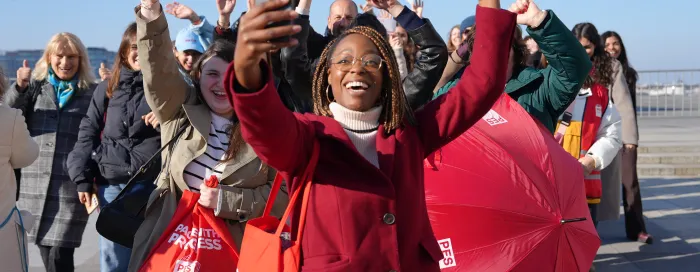
What makes a city truly inclusive? Who feels safe in public spaces, who is represented in our streets, and whose experiences are still overlooked? These were some of the questions at the heart of the PES Group's feminist walk, “Feminist City: Who Belongs in Public Space?”, held in Brussels on 5 November 2026.
Bringing together residents of Brussels, activists, PES Women representatives and women and men committed to gender equality and interested in the future of our cities, the initiative offered an opportunity to explore Brussels from a different perspective and reflect on how public spaces shape our everyday lives.
The walk was guided by Stéphanie Ngongo, City Councillor in Saint-Josse-ten-Noode, who accompanied participants from Saint-Josse through the Parc Royal to Place du Trône, exploring how the streets and public spaces we share reflect political choices and shape our sense of belonging.
From the fact that only around 6% of streets in Brussels named after people carry a woman's name, to the way something as simple as the arrangement of benches can influence who feels welcome and safe, the walk revealed how urban design, visibility and representation are deeply connected to equality.
Participants also reflected on the traces of colonial history across the city and the importance of recognising the experiences and identities of diverse communities, including the LGBTIQ+ community.
The message was clear: equality and diversity should not simply be values we celebrate, but principles reflected in the streets, squares and public spaces we share. Building a city for everyone starts by asking who it has been designed for, and who is still missing.
Drawing on the reflections and experiences shared during the walk, we spoke with Stéphanie Ngongo about what makes a city feminist, the practical changes local authorities can introduce and how residents can help shape safer and more inclusive public spaces.
Why is it important to explore a city on foot, rather than simply looking at urban planning through maps and policies? What does a feminist perspective reveal about public space?
Walking changes what we see. In a meeting room, public space is merely a map or a budget line. On foot, it becomes very concrete. Are the benches there for older residents to rest? Who actually occupies them: groups of young men, or a diverse mix of people? Who feels at ease, and where? Which streets or stations feel welcoming, and which ones would we avoid at night? Who is made visible in street names, statues and murals? Our walk started at Amazone, a Brussels house for gender equality that has brought women's organisations together under one roof since 1995. It also runs an archive and resource centre. Did you know that in Brussels, only about 6% of the streets named after a person carry a woman's name? Initiatives like this feminist walk teach us that women do not experience the city as one group. Gender interacts with origin, income, age, disability and sexual orientation. A young migrant woman, a mother with a pushchair and a woman in a wheelchair each meet different obstacles. That is why the decision-making table needs people from all walks of life. A feminist city is about safety, and about the right to belong.
What concrete measures can local and regional authorities introduce to make public spaces safer and more inclusive for women and other groups who experience discrimination?
We have more levers than we think, with changes residents notice immediately. Good lighting helps people feel safe. Neighbourhoods without sharp corners avoid blind spots where you cannot see who is coming. Pavements wide enough for pushchairs and wheelchairs, more public toilets in parks and places to change a baby's nappy allow women and parents to reclaim their public space. Even the way we place benches matters. Picture two rows of benches facing each other across a path: mostly men sit there, and women walk past quickly because they feel watched. Add tables and arrange the benches differently, and suddenly there are picnics, students studying together, older people playing cards. That is social cohesion too. Beyond design, we can tackle harassment: train staff, support reporting tools, enforce the anti-sexism law and fund awareness campaigns. Saint-Josse, for example, supported the campaign “All I want for Christmas is safer streets”. We can also change who is visible. In 2024, Saint-Josse renamed Rue De Bruyn, named after a male landowner, as Rue Marguerite Coppin, a feminist poet born in the municipality. Finally, gender budgeting and gender criteria in planning and public tenders make equality part of every decision, not a separate project.
How can local authorities ensure that women and underrepresented communities have a real voice in shaping their neighbourhoods and deciding how public spaces should look?
Residents are the real experts on their own neighbourhood: women know which corner feels unsafe and which stop is too dark. A powerful tool is the women's safety audit: mapping a neighbourhood together with residents, street by street. Participation must start before the plans are drawn, and go to where people are: school gates, markets, community centres and language classes. Language should never be a barrier to having a voice. Neighbourhoods also have their own local heroes, whose stories deserve a place in public space. And some figures honoured by one part of history cause pain to others. Belgium's history is deeply intertwined with Congo's through colonialism, which began under King Leopold II, and Belgium today is home to a large Congolese diaspora. For many of them, his statues are painful to look at. Change is possible: in 2021, Brussels residents chose to rename the Leopold II tunnel after Annie Cordy, a beloved singer and actress from Brussels. Finally, we should work with those who already have residents' trust and bring more diverse people to the decision-making table. We cannot design a city for everyone if not everyone is in the room.
The feminist walk offered a powerful reminder that gender equality must also be built into the places where we live, work and meet. From urban design and public safety to representation, participation and the recognition of different histories, local authorities have concrete tools to make a difference. For the PES Group, building fairer and more inclusive cities means ensuring that women's voices and experiences are not an afterthought, but an integral part of political decisions. Because public space belongs to everyone – and everyone should have the right to feel that they belong.